
Ready-to-use Files
Measurement result files are generated automatically for immediate analysis, archiving or sharing.
Absolute luminescence analysis
PLQY, ELQY & QFLS - in seconds
LuQY Pro is a compact, fully integrated system for absolute photo- and electroluminescence analysis of thin films, layer stacks and complete optoelectronic devices. It measures PLQY and ELQY and directly determines the quasi-Fermi level splitting (QFLS / iVoc) under controlled optical and electrical operating conditions. Automated measurement and analysis deliver reliable results within seconds.

Overview
LuQY Pro is an integrated measurement system for the characterization of luminescent materials and optoelectronic devices. It combines optical excitation, electrical control, absolute light collection and spectral analysis in a single instrument.
The system measures photoluminescence quantum yield (PLQY) and electroluminescence quantum yield (ELQY). From the measured emission data, it also determines the quasi-Fermi level splitting, commonly expressed as QFLS or implied open-circuit voltage (iVOC).
During a measurement, the sample is excited optically by a controlled laser source or electrically through the integrated source measure unit. The emitted light is collected by an integrating sphere and analyzed by a spectrometer. All relevant optical and electrical signals are recorded and processed automatically by the LuQY Control software.
The complete workflow covers motorised excitation control, data acquisition, automated calculations and integrated analysis. It is designed to minimize manual steps and reduce measurement variability. Standard measurements can be completed within seconds, while measurement parameters remain fully accessible for more detailed investigations.
LuQY Pro can be used with thin films, multilayer stacks and complete devices. Its integrated design makes it suitable both for routine characterization and for more advanced experimental workflows where controlled and reproducible operating conditions are required.

Measurement result files are generated automatically for immediate analysis, archiving or sharing.
Store results directly in your existing database infrastructure.
Connect instrument control and data acquisition to custom software and automated laboratory workflows.
View API DocumentationConnect results to QYB Lab or NOMAD Oasis for structured data management and research workflows.
Complete optical unit calibrated with a NIST-traceable reference source.
Every system is tested and commissioned by QYB.
Measurement and analysis methods supported by peer-reviewed scientific literature.
Every LuQY Pro is individually tested and calibrated by QYB before delivery. The integrating sphere and spectrometer are calibrated as a complete measurement unit using a NIST-traceable reference source to support consistent and reproducible absolute measurements.
The system is designed in accordance with applicable European electrical, electromagnetic compatibility and laser safety requirements.
LuQY Pro is built on measurement and analysis methods established through fundamental scientific research and peer-reviewed literature. Today, the system is used by specialists across the world to investigate photovoltaic and optoelectronic materials, identify recombination losses and support the development of advanced devices.
Specifications
| Parameter | Specification |
|---|---|
| Measurement | |
| Measurement modes | Absolute photoluminescence and electroluminescence |
| Calculated results | PLQY, ELQY, QFLS / iVOC |
| Minimum resolvable luminescence quantum yield | 10⁻⁶ (0.0001%) |
| Spectrometer integration time | 1 ms–35 min |
| Spectral sampling interval | 1 nm |
| Signal-to-noise ratio | 600:1 |
| Optical excitation | |
| Excitation wavelength | |
| Compatible spectral detection range | 450–1050 nm |
| Photoexcitation intensity | 0.0001–10 suns, continuously adjustableThe achievable equivalent-sun intensity may depend on the sample absorption, band gap and selected spot size. |
| Excitation spot size | 0.1 cm² / 1 cm², selectable |
| Electrical system | |
| Integrated source and measure unit | Yes |
| SMU maximum ratings | ±10 V, ±150 mA |
| Voltage source accuracy | 10 mV |
| Voltage sensing precision | 50 µV |
| Current sensing precision | 100 nA / 1 µA / 10 µA, depending on the selected range |
| Contactable subcells | Up to 6 via integrated relay box |
| Sample handling | |
| Maximum sample dimensions | 30 × 30 mm |
| Sample holder | Customizable |
| Excitation spot selection | Motorized switching between 0.1 cm² and 1 cm² |
| System | |
| Dimensions (W × D × H) | 220 × 390 × 130 mm |
| Weight | 6.1 kg |
| Computer connection | USB 3.0 |
| Power connection | DC |
| Calibration | |
| Excitation calibration | Calibrated against certified reference solar cells |
| Spectral calibration | NIST-traceable reference source |
| Recommended calibration interval | 1 year |
Applications · LuQY Pro
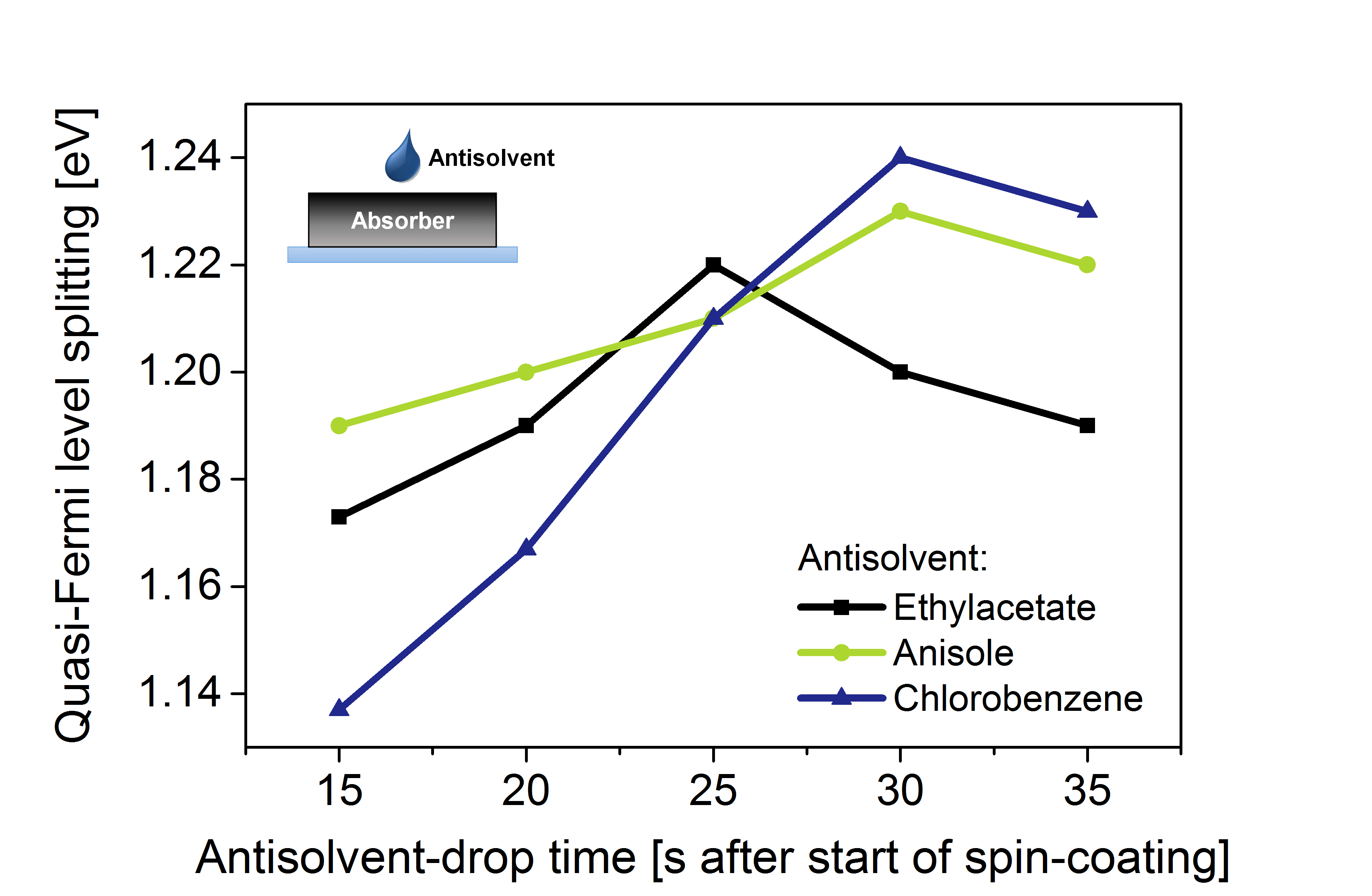
Quality assessment for rapid process control after each fabrication step or for accelerated material and process parameter screenings.
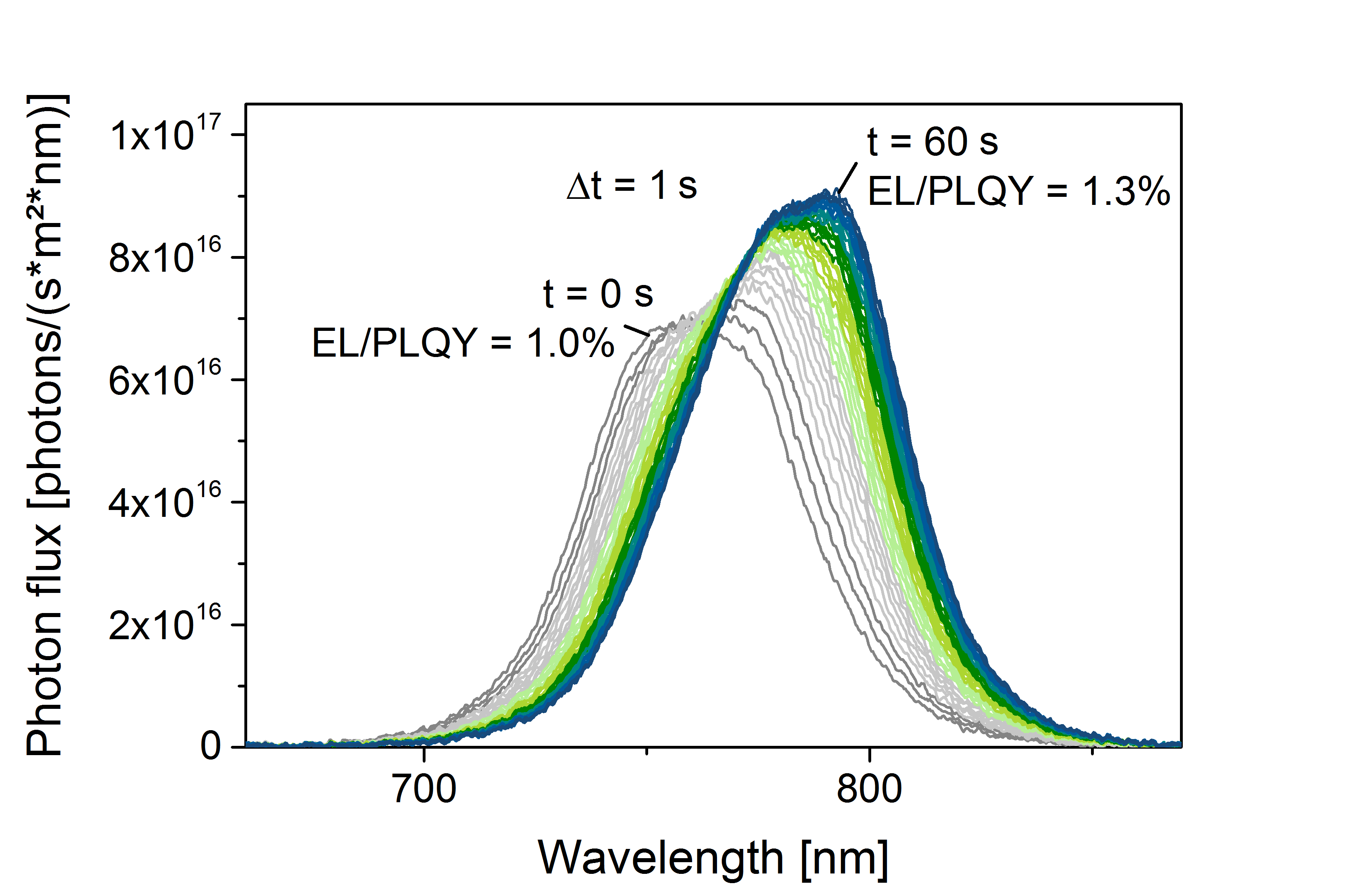
Fast acquisition resolves shifts in emission spectrum and intensity, as well as EL / PLQY and QFLS, on timescales from 10 ms to several hours.
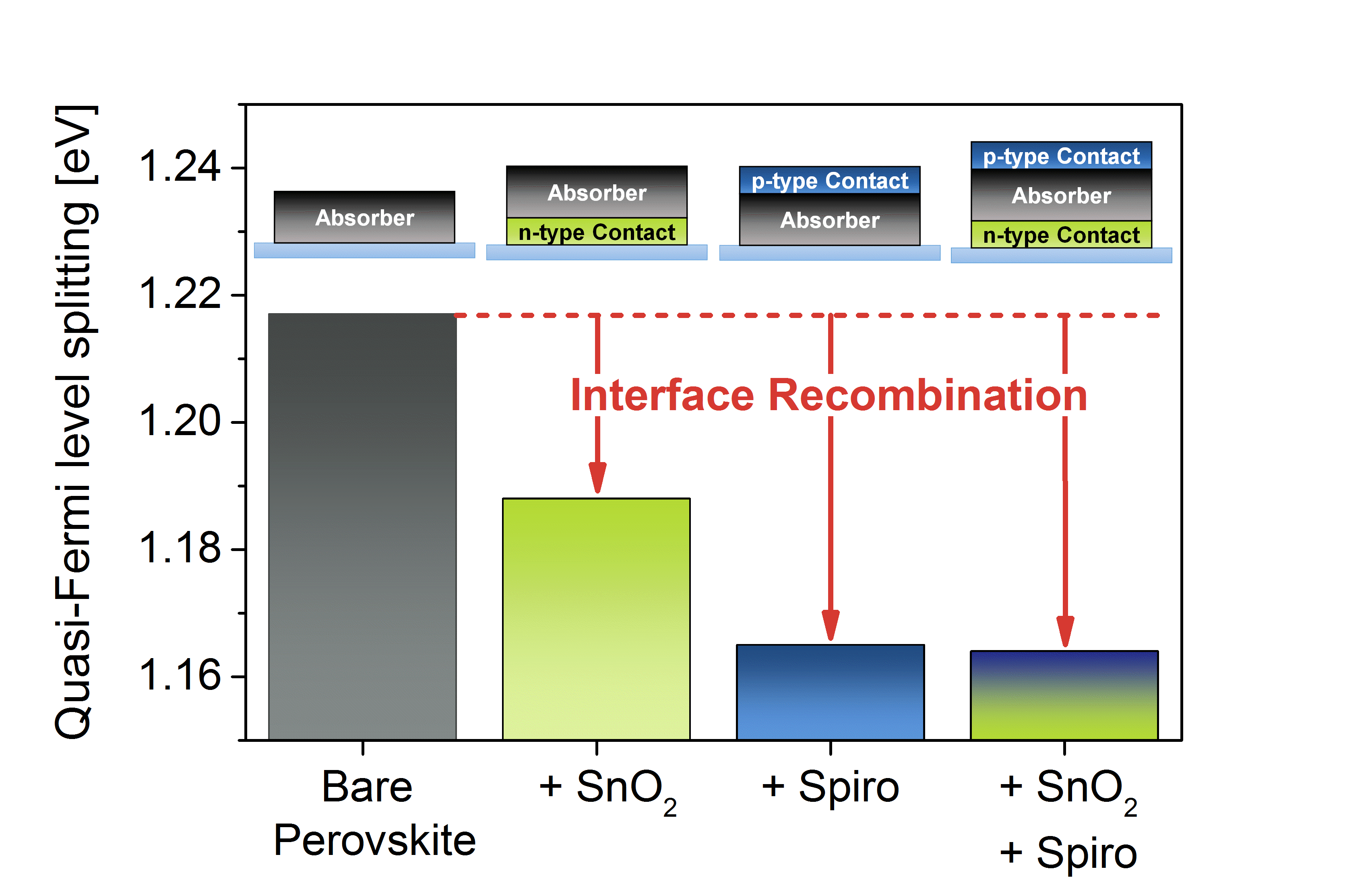
Quantifying bulk and interface recombination losses in semiconductor thin films, layer stacks or complete devices such as solar cells or LEDs. Examples in academic publications can be found in [1–6].
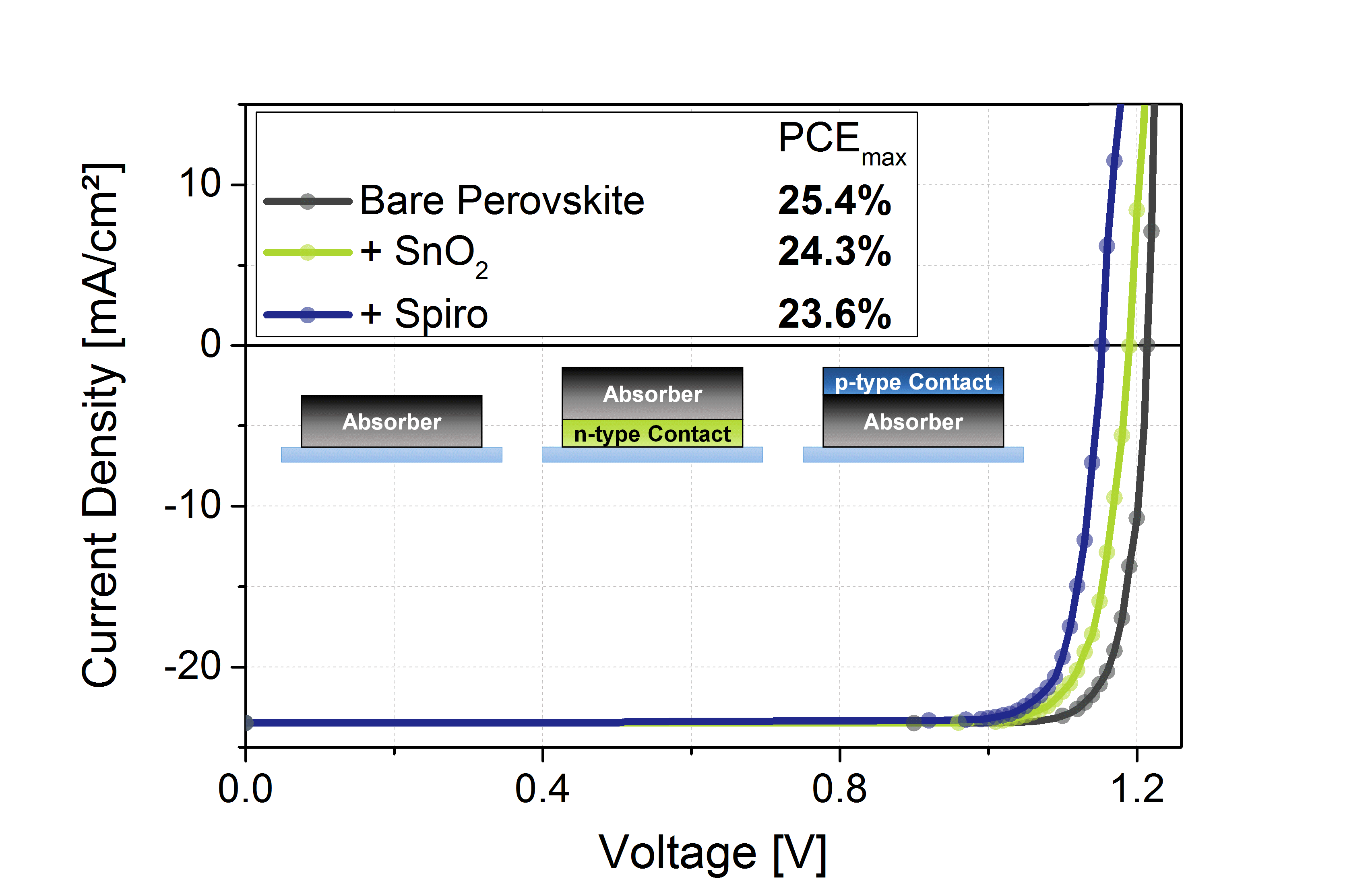
In-depth analysis of efficiency potentials and loss mechanisms in semiconductor thin films, layer stacks or complete devices, for example by determining ideality factors and pseudo-JV curves from intensity- and/or bias-voltage-dependent EL / PLQY and iVOC. See also [7–9].
Scientific references
Recombination analysis
Efficiency analysis
Downloads
LuQY Pro in research
Researchers worldwide use LuQY Pro to investigate photovoltaic and optoelectronic materials, quantify recombination losses and support advanced device development.
Explore peer-reviewed research